
When you’re buying a home and the builder says, “Sir, our project is RERA-approved,” it sounds great. But there’s a subtle technical detail you need to understand. In the real estate market, the words “Approved” and “Registered” are often used interchangeably, but do they mean the same thing?
Let’s clear up this confusion once and for all and easily understand the difference between RERA Registered and RERA Approved.
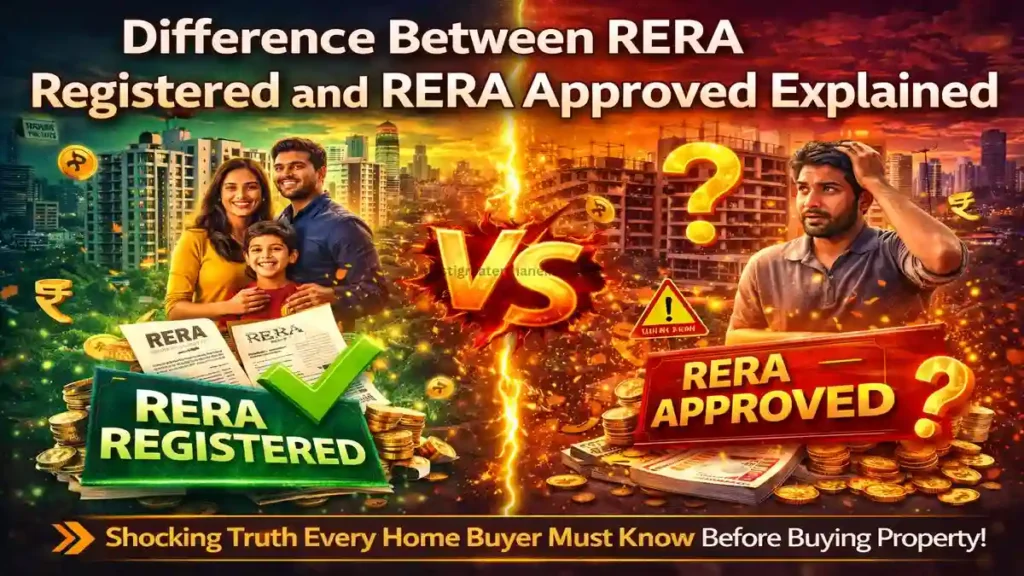
Difference Between RERA Registered and RERA Approved: What’s the Truth?
There is no official term like “RERA Approved” in the RERA Act. RERA is a regulatory body that ‘registers’ projects, not “approves” them.
When a project follows all of RERA’s rules and uploads all its documents, such as maps, land titles, and construction timelines, to the RERA portal, it is assigned a Unique RERA Registration Number. Builders often call it “RERA Approved” for marketing purposes to make buyers think it has government approval. In reality, you should only look for the RERA Registration Number.
What Does It Mean to Be RERA Registered? (The Legal Side)
When we say a project is RERA registered, it means the builder has legally registered themselves and their project under the Real Estate (Regulation and Development) Act, 2016.
- Mandatory Status: Every project that is over 500 square meters or has more than 8 apartments is required to have RERA registration.
- Transparency: Registration means the builder has uploaded all land documents, the architect’s plan, and the possession date to a government website. You can check from home how much of the work has been completed.
- Financial Safety: For RERA-registered projects, the builder is required to keep 70% of the money received from buyers in a separate escrow account, which they can only use for construction.
Link Between RERA Compliance and Local Approvals
In real estate, the actual “approval” process is handled by local planning authorities, such as the MCGM in Mumbai, the PMRDA in Pune, or the TMC in Thane. These authorities approve the building’s plan and layout. For RERA registration, the builder must obtain a Commencement Certificate (CC) from these local authorities.
For more legal information and regulations about RERA, you can refer to the Ministry of Housing and Urban Affairs (MoHUA) website, which is the nodal body implementing RERA guidelines across the country.
RERA Approved: Is It Just a Marketing Term?
When a builder says a project is “RERA Approved,” they are technically combining two different things. RERA is not an “approval agency” that reviews and approves your building’s design.
In reality, before bringing a project to the market, the builder has to clear two major hurdles:
- Local Authority Approvals: First, the builder has to get the plan approved from a local authority like the BMC or TMC. This is what is actually called the “approval.”
- RERA Registration: Once the local approvals are obtained, the builder registers their project with RERA.
“RERA Approved” is written in marketing brochures because for the average person, ‘Approved’ means “government-approved.” But you should always ask the builder for their Registration Number, not just rely on the “Approval.”
Comparison Table: RERA Registered vs RERA Approved
I have created this simple table to clear up your confusion:
| Feature | RERA Registered | RERA Approved (Marketing Term) |
|---|---|---|
| Technically Correct? | Yes, this is a legal term. | No, this is just colloquial language. |
| Main Objective | Transparency and buyer safety. | Just to show that the project is legal. |
| Authority | State RERA Authority (e.g., MahaRERA) | Local Municipal Corporation + RERA. |
| Evidence | You receive a unique registration number. | Just the builder’s promise or a printed brochure. |
| Online Verification | It can be checked on the RERA website. | Just the builder’s promise or a printed brochure. |
Why You Should Only Buy RERA-Registered Projects?
Investing in an unregistered project is like riding a bike without a helmet because the risk is very high.
- Grievance Redressal: If a project is registered and the builder stops work, you can file a complaint with the RERA Authority. Without registration, RERA cannot help you.
- Standardized Carpet Area: In registered projects, builders are only allowed to charge based on the “Carpet Area.” They cannot mislead you with terms like “Super Built-up.”
Step-by-Step: How to Verify a RERA Number?
Each state has its own RERA portal, such as MahaRERA for Maharashtra and UP-RERA for Uttar Pradesh. The verification process is almost the same:
- Go to the Official Website: Always open the official site with .gov.in. (E.g., maharera.maharashtra.gov.in).
- Search Project Tab: On the homepage, look for the “Registration” or “Search Project” option.
- Enter RERA Number: Enter the registration number provided by the builder (e.g., P517000XXXXX). If the number is not available, enter the project name or the builder’s name.
- Analyze the Dashboard: When the project name appears, click “View Details.” Here, you must check these 3 things:
- Proposed Completion Date: Is this the same date the builder told you? Often, the builder will say 2026, but RERA will show 2028.
- Litigation Details: Is there any court case pending against this project?
- Sanctioned Plans: Is the builder constructing the same floor plan that is approved on RERA, or a different one?
Conclusion
The difference between RERA registered and RERA approved is that “Approved” is just a comforting word, whereas “Registered” is a legal safety net. In 2026, a smart buyer is one who trusts the data on the RERA portal more than glossy brochures.
Buying a home is the biggest investment of your life; don’t leave it to just an “Approval.” Ask the builder for their RERA Registration Number and verify it yourself.
Frequently Asked Questions
Can a builder change the plan after RERA registration?
Absolutely not. According to RERA rules, if a builder wants to make any major changes to the sanctioned plan, they must obtain written consent from at least two-thirds (2/3rd) of the buyers.
Is RERA mandatory for old buildings or redevelopment projects?
If an old building is being redeveloped and new flats are being sold (Sale Component), then it is mandatory for the builder to get RERA registration. Only those redevelopment projects where no new flats are being sold are exempt.
What should you do if the RERA number turns out to be fake?
This is a serious matter. If the builder is showing a fake RERA number, you can immediately go to the RERA authority’s website and file a “Non-Registered Project” complaint. The builder can be fined up to 10% of the project’s cost.
Are RERA-approved plots safe?
In the case of plots, “Layout Approval” is granted by the local authority, but RERA registration is still required to sell them. Plots without a RERA number always carry the risk of boundary disputes or possession issues.
