
Investing in real estate can be a smart and life-changing decision, but only if you have a proper understanding of the market. People are often confused about where to start. If you want to know in simple terms what are the 4 types of property are, here is the clearest answer.
According to the basic rules of the real estate market, properties are divided into these 4 main categories:
- Residential Property: Homes, apartments, or villas for living.
- Commercial Property: Shops, offices, and malls for running a business.
- Industrial Property: Factories, manufacturing units, and large warehouses.
- Land: Vacant land, agricultural land, or non-agricultural (NA) plots.
These 4 types of real estate are completely different from one another. Their risk, return on investment (ROI), and purchasing methods differ. In this guide, let’s understand where it would be best for you to invest as an investor.
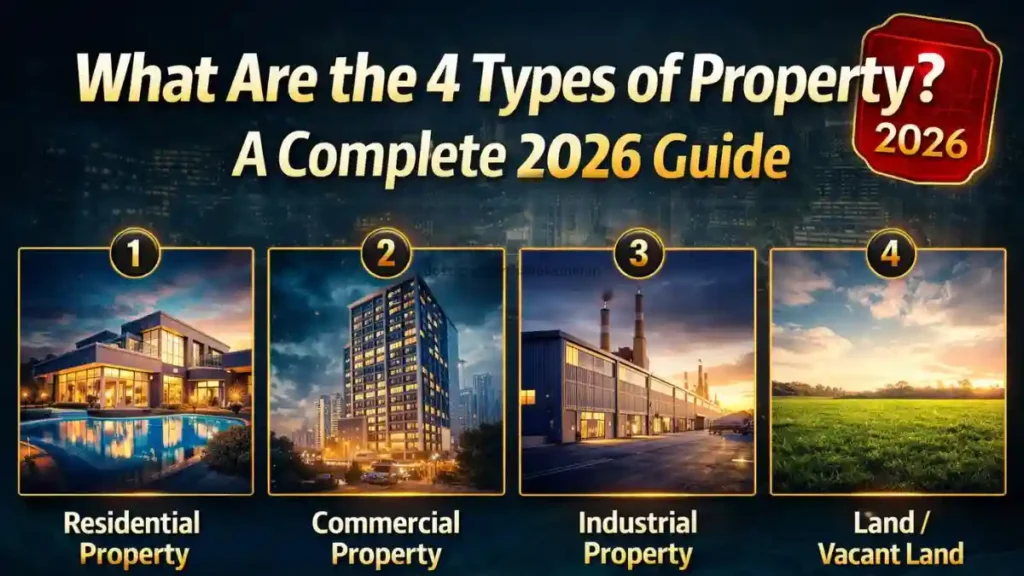
What Are the 4 Types of Property
1. Residential Property (Living Space)
Whenever an ordinary person dreams of buying property, the first thing that comes to their mind is their own ‘home’. In simple terms, residential property means a place where people live privately with their families. Permission for any kind of business or commercial activity is not allowed here.
This real estate property classification generally includes:
- Apartments / Flats: One of the most common and high-demand options in today’s metro cities.
- Independent Houses / Villas: Luxurious and private homes built on their own plots of land.
- Housing Societies & Condos: Gated communities that offer common amenities like security, swimming pools, and parks.
Why Is It Safe for Beginners?
If you’re planning to invest in different types of property for the first time, residential real estate is considered the safest (lowest-risk) option. The logic is very simple: no matter how many ups and downs the economy goes through, people will always need a roof over their heads.
However, the rental income (the rent you receive each month) is somewhat lower compared to commercial space (typically 2% to 4% of the property’s value per year). However, the property’s value (capital appreciation) increases very steadily over time. To track the growth of India’s housing market, you can refer to the Reserve Bank of India’s (RBI) official House Price Index (HPI), which shows that residential properties have consistently shown growth over the long term.
Additionally, the government also provides homebuyers with affordable home loans and substantial income tax deductions (Sections 80C and 24b), making it easier for the average person to enter this market.
If you want to earn regular, substantial money (high rental income) from real estate, the next level after residential properties is commercial and industrial real estate. Let’s take a detailed look at these two major players.
2. Commercial Property (For Business)
In simple terms, any building or land where people conduct business and earn money is called commercial property. People don’t come here to live, but to work, shop, or get services.
If we talk about types of commercial real estate, they include:
- Retail Shops & Showrooms: Stores in markets or on high streets and showrooms for major brands.
- Office Spaces: From small cubicles to IT parks for large IT companies and co-working spaces.
- Shopping Malls & Multiplexes: Large commercial complexes that house multiple businesses under one roof.
- Hospitality: Hotels, restaurants, and cafes.
Why Do Investors Like It?
If you want a solid monthly income (rent) from your real estate investment, then commercial property is the best option for you. While residential flats offer an annual rent of only 2-3% of the property’s value, in commercial spaces, this easily ranges from 6% to 10%.
Additionally, the tenant is typically a company or business owner who handles their own office interior and signs a long-term lease (3 to 9 years). This means you don’t have the stress of constantly finding new tenants.
3. Industrial Property (Factories & Warehouses)
This is the part of real estate that is a bit out of the public eye. It is typically located on the outskirts of a city or in Special Economic Zones (SEZs). This is where things are manufactured or stored.
Industrial property investment mainly involves 3 types:
- Manufacturing Units: Large factories with machinery where production takes place (e.g., a garment or car manufacturing factory).
- Warehouses: Large, empty buildings where Amazon, Flipkart, or FMCG companies store their goods.
- Logistics Hubs: Centers from which the packing, shipping, and delivery of goods are managed.
Why Invest in It?
In today’s world, with online shopping (e-commerce) growing so rapidly, the demand for warehouses is skyrocketing. For a smart investor, industrial real estate can become a ‘cash cow’ (a machine that generates consistent income).
The biggest advantage is that the lease agreements are for very long terms, sometimes lasting 10 to 15 years. Once a major company leases your warehouse, you’ll receive a fixed income for years, and the tenant handles the major maintenance themselves. However, the initial investment (entry ticket) is typically very large, which is why only large investors show much interest in it.
If there is any most basic and oldest form of real estate investment, it is land. Without land, the three types above (residential, commercial, and industrial) simply do not exist. Let’s take a closer look at this final type.
4. Land / Vacant Land
Land is something that humans cannot create in a factory, nor can they increase its supply. Therefore, its demand is always increasing. In simple terms, any area where no construction (building or structure) has taken place is called land real estate.
If we talk about the types of land real estate, it is mainly divided into the following categories:
- Agricultural Land (Farm Land): This land is used solely for farming. It is relatively inexpensive to purchase, but you cannot legally build a house or factory on it.
- Non-Agricultural (NA) Plots: These are plots of land that the government has cleared for purposes other than farming, such as building houses or shops. Their demand and rates are both very high.
- Raw Land (Undeveloped Land): Land that does not yet have basic amenities like water, electricity, or roads.
Benefits of Investing in Land:
A smart investor sees land as a blank canvas. You don’t have to maintain a building, nor do you have to listen to a tenant’s complaints. You buy the land and simply wait for its price to increase (appreciation) over time. However, there is a slight risk of encroachment, so building a boundary wall is always necessary.
Comparison: Residential vs. Commercial Property
Often, new property buyers are torn between residential and commercial property. Both have their own advantages and disadvantages. If you’re confused, this comparison table will help you fully:
| Feature | Residential Property (House/Flat) | Commercial Property (Shop/Office) |
|---|---|---|
| Rental Yield | It happens (2% – 4% of the value annually) | It’s too much (6%–10% of the value per year) |
| Risk Level | Low risk (considered a safe investment) | A bit more risk (depending on the economy and the market) |
| Maintenance Cost | My landlord often has to oversee repairs on the apartment. | The tenant (company) handles its own interior repairs. |
| Budget Entry Ticket | You can start on a small budget. | It requires a large amount of capital (a lot of money) and a higher down payment. |
| Lease Period (Agreement) | Chota (Generally a 11-month lease agreement) | Long-term (solid contract for 3 to 9 years) |
Frequently Asked Questions
Which of all these property types in the real estate market is the most profitable?
If you’re only talking about monthly rental income, commercial and industrial properties are the most profitable. But if you want long-term capital appreciation and safety without any headaches, land and residential options are considered the best.
Where should beginners start investing?
Beginners should always start with residential properties (like a 1BHK/2BHK flat) or small-sized plots. This way your risk is very low, it’s very easy to get a home loan from the bank at low interest rates, and you also get a good income tax rebate.
Can I buy agricultural land (farm land) and build my house on it?
No, legally you cannot build a residential or commercial structure directly on agricultural land. To do so, you must first have the local government authority change the land’s “Land Use” designation and convert it into an NA (Non-Agricultural) plot.
Can I withdraw my provident fund (EPF) for property investment?
Yes! According to EPF rules, if you have completed 5 years of service, you can legally withdraw money from your PF account up to a certain limit to buy your first home, purchase land, or build a house.
Conclusion
Friends, understanding the concept of what are the 4 types of property is the first step in any successful real estate journey. Whether you’re looking for a home to live in or a commercial shop to earn passive income every month—choose the right type based on your budget, risk tolerance, and future goals. Don’t rush in the real estate market, do proper research, and always be sure to check the legal documents (RERA/Title Deed).
