
Friends, if you’re planning to buy a plot, land, or flat in Maharashtra especially around Thane, Bhiwandi, or Kalyan in the emerging rural and Gram Panchayat areas you’ve probably heard your brokers and agents mention one term over and over: “8A” or “Namuna 8A.” New homebuyers often get confused exactly what is 8A in property, and why is there so much fuss about it when finalizing a deal?
If you’re searching online for a straightforward, concrete answer, the reality is that Namuna 8A, or Village Form 8A, is an official property tax document issued by the Gram Panchayats of Maharashtra. It serves as proof of who is registered on the tax register (khata) for a specific piece of land or house, the size of the property, and whether its municipal tax (lagan) is being paid regularly or if there are any outstanding dues.
Often people consider only the 7/12 utara (saat-bara) document as everything, but the truth is that without any 8a property document, your property file is considered incomplete for a bank loan or registration. Let’s break down this technical-sounding government document so you can easily understand it, so that next time you go to view a property or deal with a broker, you’ll have complete knowledge about it.
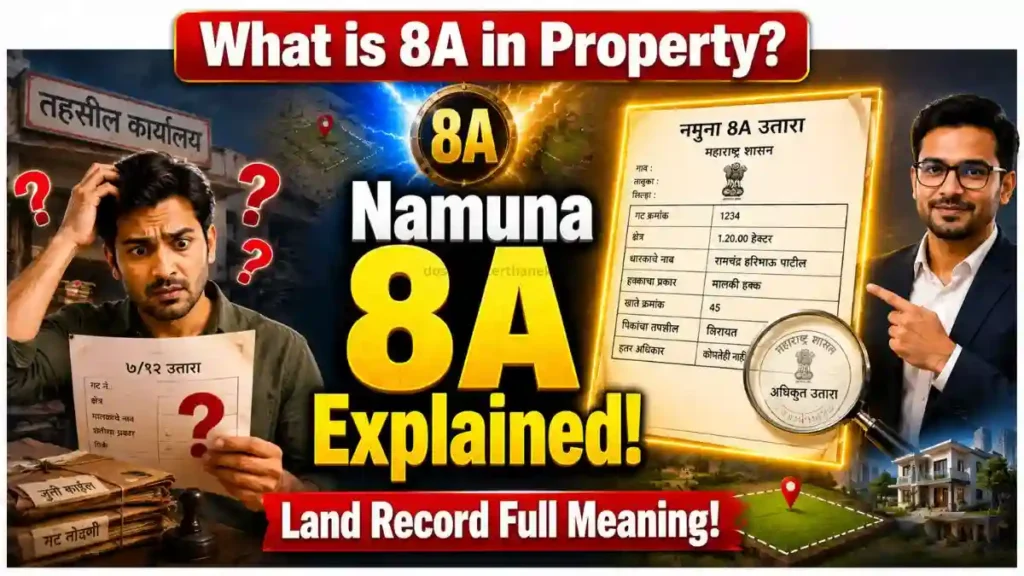
What is 8A Property Document? (Namuna 8A Explained)
In simple terms, just as we receive a property tax receipt every year in the city (within Municipal Corporation limits), the same “Namuna 8A extract Maharashtra” is used within the limits of a village or Gram Panchayat. This is a page (extract) from the Gram Panchayat’s official register where the complete ‘khata’ (account) of your property is maintained.
When you search online for “what is 8a in property,” it’s crucial to understand that this single sheet of paper holds the complete financial history of your plot or flat. Let’s look at the details practically: when you hold this document in your hands, what information will be recorded in it:
- Owner’s Name (Taxpayer): Who is currently paying the property tax and who is the original taxpayer (landholder) on the Panchayat’s records.
- Khata Number & Property Details: The exact area of your land or house (in guntha or sq ft), the plot dimensions, and its unique khata (account) number in the village’s official records.
- Tax Assessment (Lagan): The total annual property tax, how much has been paid so far, and whether there are any outstanding dues owed to the government.
Many new investors think that obtaining this document requires an expert lawyer, but in today’s digital age you can easily go to the Mahabhumi 8A online portal to verify and download it.
In fact, “8a utara meaning in English” simply means “Village Form 8A,” which is the official government proof of your financial and tax liabilities. Imagine if you buy a property whose taxes haven’t been paid for the past 10 years; the Gram Panchayat will then pass all that pending tax on to you! To avoid this risk, the Namuna 8A is placed at the very front of property transactions.
What is the difference between 7/12 Utara and 8A Extract?
Remember one simple rule: 7/12 shows your land ownership, while 8A shows your tax liability (financial details) on that land. Without both of these, your property paperwork remains incomplete.
Let’s understand this difference between 7/12 and 8A with the help of the simple table below:
| Feature | 7/12 Utara (Saat-Bara) | Namuna 8A Extract |
|---|---|---|
| Main Purpose | This proves the land’s title (ownership) and land type (agricultural or non-agricultural). | It works like a gram panchayat property tax receipt and shows tax clearance. |
| What are the details? | The physical area of the land, details of the crops, and the owner’s name. | Khata number, tax (lagan) amount, and taxpayer’s name. |
| For a bank loan | Upon seeing this, the bank confirms who has legal rights to the land. | Upon seeing this, the bank confirms that there are no outstanding government tax dues on the property. |
| Who issues it? | Talathi (Revenue Department) | Gram Panchayat (Maintained by the Talathi) |
When you buy a property, you need to verify both of these documents together. If someone else’s name appears on the 7/12 and the 8A (tax receipt) is issued in someone else’s name, understand that there may be a dispute over the property.
Key Benefits of Sample 8A (Top Uses of the 8A Extract)
Now you understand what is 8A in property, but the question is: where will this document be used in practice? Let’s see how powerful this seemingly ordinary-looking paper is:
- Secure Property Registration: When you buy a flat or land in a Gram Panchayat area and go to the Sub-Registrar office to register it, the property registration documents must include Namuna 8A as per the Maharashtra list. This proves that the previous owner has cleared all taxes and that no government liability will pass to the new owner.
- For a Home Loan (Bank Approvals): In villages or peri-urban areas (like the outskirts of Bhiwandi or Kalyan), housing finance companies and banks first ask for your 8A. The main reason these 8A extracts are used for home loans is that banks want to verify whether the property appears in the Gram Panchayat’s official tax records or if it’s an illegal/unauthorized construction.
- To Get the Property in Your Name (Mutation): After buying the property, when you go to the Gram Panchayat office to get your name transferred (mutation/ferfar), you have to submit the previous owner’s clear 8A extract; only then is a new khata opened in your name.
Friends, the 8A extract looks like a small government slip, but without it your property’s legal journey can’t move forward.
How to Get 8A Extract Online in Maharashtra?
In the past, you had to run around government offices and the Talathi office for a small piece of paper. But now, in the era of Digital India, the process of getting an 8A extract online has become very simple. You can easily download it from your mobile or laptop, right from home, without paying an agent.
Let’s look at its easy step-by-step process:
- Go to the Official Website: First, visit the official Mahabhumi Bhulekh Portal of the Maharashtra Revenue Department. This is the government’s authorized portal where all land records are stored securely.
- Select Region: On the home page, on the right side, select your ‘Section’ or division (like Konkan, Pune, Nashik) and click ‘Go’.
- Choose the 8A Option: On the next page, you will see options for ‘7/12’ and ‘8A’. Select the ‘8A’ radio button here.
- Enter Your Area: Now, select your Zilla (District), Taluka, and Gaon (Village) from the dropdown menu.
- Search: You can search for your property in several ways—by Khata number, First Name, Last Name, or Full Name. Enter the correct details and click ‘Search’.
- Download PDF: Verify your details, enter your mobile number, and as soon as you click ‘View’, your Mahabhumi 8A online extract will appear on the screen. You can download or print it from there in PDF format.
Frequently Asked Questions
Is an 8A extract proof of property ownership (maliqana haq)?
No! This is a big myth among people. Form 8A is just a tax record that shows under which taxpayer’s name the property’s taxes are being paid. The real proof of ownership is your 7/12 extract, the sale deed (registry paper), or Index II.
Who issues the 8A extract in Maharashtra?
This document is prepared and maintained by the village’s Talathi (Revenue Officer). The Talathi is also responsible for collecting taxes and maintaining the accounts (Namuna 8) for all lands and properties under the Gram Panchayat.
Do flats in the city also require an 8A?
If your flat or land falls within the limits of a major municipal corporation (like TMC, BMC, or PMC), then an 8A extract isn’t required. A direct municipal corporation property tax receipt (tax bill) is accepted. 8A is specifically designed only for Gram Panchayats or rural areas.
Conclusion: Right Information, Safe Investment
Friends, investing your money in the property market is one of the biggest and most emotional decisions in life. If you’ve read this guide carefully, you now fully understand what is 8A in property is and how this small form plays a huge role when finalizing any property deal or home loan.
The next time you go to see a plot or flat in Thane, Kalyan, or any Gram Panchayat area, be sure to ask the broker or seller for the 7/12 extract along with the Sample 8A. This will clear up the property’s tax history and save you from any hidden government penalties or dues. Always verify your documents yourself, be a smart buyer, and secure a safe and stress-free deal.
