
Friends, when a new guest (baby) is about to arrive in the house, along with the joy, the family also has concerns about the expenses. Especially for poor and BPL (Below Poverty Line) families, delivering in a hospital becomes a financial burden. To reduce this burden and keep both mother and child safe, the Indian government launched the Janani Suraksha Yojana.
The Janani Suraksha Yojana (JSY) is a 100% centrally sponsored scheme under the National Health Mission (NHM). Its main objective is to encourage pregnant women to have safe deliveries (institutional deliveries) in government hospitals. To do this, the government sends direct financial assistance (cash assistance) ranging from ₹1,000 to ₹1,400 to their bank accounts.
These days, everyone on the internet is looking for the right way to apply online for the Janani Suraksha Yojana. After all, where do you submit the form and what is the Janani Suraksha Yojana eligibility? Today, we will explain the answers to all these questions so that you don’t face any confusion and can easily fill out your form.
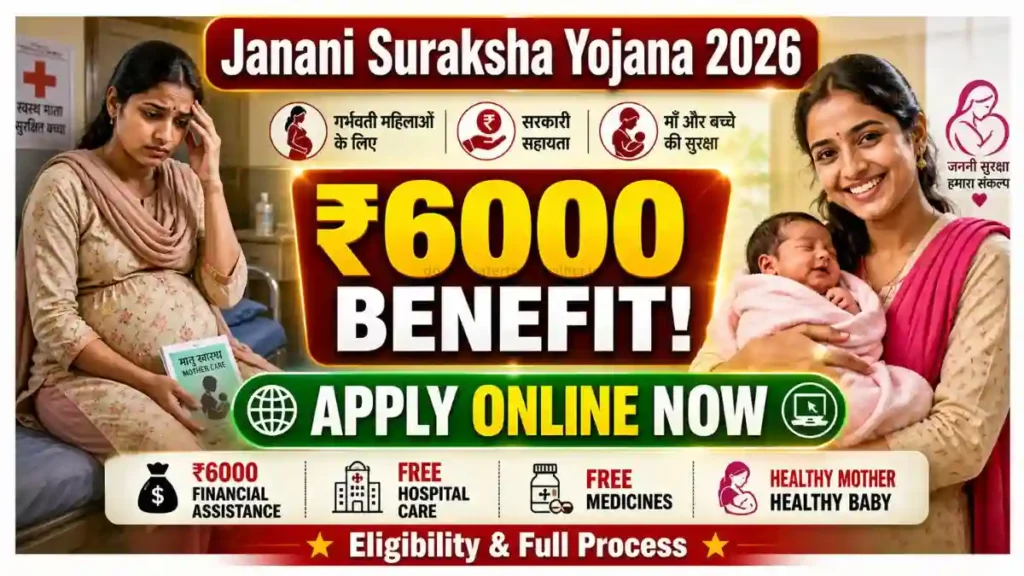
What is the Janani Suraksha Yojana?
To put it simply, a few years ago, most deliveries in villages and small towns took place at home. Because of this, if complications like infection or bleeding occurred, the mother’s and baby’s life was in great danger. The government has taken a tremendous step to solve this problem at its root, which is the Janani Suraksha Yojana.
The government has a very big goal behind this scheme. If you are pregnant and have your check-ups and delivery at a government hospital (Government Hospital, CHC, or PHC), then the government will not only provide your treatment free of charge, but will also give you cash for a good diet and transportation expenses. These cash benefits are what we call JSY scheme benefits.
The biggest heroes of this entire program are our ASHA (Accredited Social Health Activist) workers. ASHA didi is the one who identifies pregnant women, takes them to the hospital, and stays with them from filling out their Janani Suraksha Yojana form PDF until they are discharged. This scheme has rapidly reduced the maternal mortality rate across the country, because now no poor woman risks an unsafe home delivery due to a lack of money.
Friends, before filling out the form, everyone has the same question: “How much money will we get under this scheme?” So let’s clear up this confusion. The government has divided the country’s various states into two categories based on their health conditions:
- LPS (Low Performing States): Such as UP, Bihar, MP, Rajasthan, Chhattisgarh, etc. The institutional delivery rate is low here, so the benefits are higher.
- HPS (High Performing States): Such as Maharashtra, Gujarat, Kerala, etc. Medical facilities are better here.
Let’s understand the Janani Suraksha Yojana scheme amount for these two categories and for villages/towns in the simple table below:
JSY Scheme Benefits: How Much Money Will You Get?
For LPS (Low Performing States):
| Area | Mother’s Package (For the Woman) | ASHA Didi’s Incentive | Total Amount |
|---|---|---|---|
| Rural Area | ₹1,400 | ₹600 | ₹2,000 |
| Urban Area | ₹1,000 | ₹400 | ₹1,400 |
For High Performing States (HPS):
| Area | Mother’s Package (For the Woman) | ASHA Didi’s Incentive | Total Amount |
|---|---|---|---|
| Rural Area | ₹700 | ₹600 | ₹1,300 |
| Urban Area | ₹600 | ₹400 | ₹1,000 |
From the table above, you’ll have understood that the government not only provides money to the mother for her diet but also gives incentives to the ASHA worker for safely taking her to the hospital, which also generates income for the ASHA worker. These JSY scheme benefits are deposited directly into the woman’s bank account.
Janani Suraksha Yojana Eligibility (Who Can Apply?)
After going over the financial details, let’s get to the main point: do you qualify for this scheme? The government has set some basic rules for Janani Suraksha Yojana eligibility so that the benefits reach the right needy individuals.
Let’s understand these in clear bullet points:
Institutional Delivery (Hospital Birth): You will only receive the benefits of this scheme if your delivery takes place in a government hospital (Government Hospital, CHC, PHC) or in a government-accredited private hospital. For a home delivery, the woman is given only ₹500 in assistance.
- LPS States Rule: If you are from LPS states (like UP, Bihar), then all pregnant women (whether BPL or APL) who deliver in government hospitals are eligible for this scheme. There is no age or child-count restriction here.
- HPS States Rule: If you are from an HPS state (like Maharashtra), the woman must be 19 years of age or older. Additionally, the woman must have a BPL (Below Poverty Line) card or proof of SC/ST category. In HPS, this benefit is only available for the delivery of the first two living children.
- Mother and Child Card: The woman must have a JSY card or an MCP (Mother and Child Protection) card, which is issued by the ASHA at the time of registration.
If you meet these simple conditions, then you are all set to fully benefit from your Janani Suraksha Yojana!
Required Documents for Janani Suraksha Yojana
It can be a bit difficult to navigate government offices without the proper paperwork. Therefore, prepare a file in advance before you go to the hospital to ensure there is no delay in receiving your payment.
Here is a clear checklist of all the required documents for JSY:
- Aadhaar Card (Mother’s): The woman’s Aadhaar card is the most essential. Make sure the Aadhaar is linked to a mobile number.
- Bank Passbook (DBT Enabled): The woman should have her own active bank account. The most important thing is this account must be linked to her Aadhaar and to Direct Benefit Transfer (DBT). If DBT is not enabled, the government will send the money, but it will not be credited to your bank account.
- JSY Card / MCP Card: When a woman registers her first pregnancy with an Anganwadi or ASHA worker, she is given a Mother and Child Protection (MCP) card. This card must be shown at the hospital.
- BPL Ration Card: If you are from an HPS (High Performing States), a BPL card or SC/ST certificate is required. This is not required in LPS states.
- Discharge Ticket: After giving birth and being discharged from the hospital, you will receive a discharge ticket. This serves as proof that the delivery took place in an institutional setting (hospital).
Janani Suraksha Yojana Application Process (Offline & Online Guide)
Many people search online for how to apply for the Janani Suraksha Yojana and about its portal. Let’s understand the reality of this process.
The Reality Is This (The Offline Process):
In 90% of cases, the Janani Suraksha Yojana application is done offline, because the backbone of this scheme is our ASHA workers. The process is very simple:
- When you are pregnant, meet with the ASHA didi or Anganwadi worker in your village/ward.
- She will register you and give you the MCP (JSY) card.
- The ASHA will take you for your check-ups and will also help you at the hospital to get the Janani Suraksha Yojana form filled out. You just need to give your documents to her and to the hospital clerk.
Online Tracking & Official Portal:
After submitting the form, if you want to check the payment status of your installment, you will need to visit the Janani Suraksha Yojana official website. Different states have their own NHM (National Health Mission) portals.
You can visit the official National Health Mission (NHM) website to find your state’s health portal and track your DBT status using your MCP card number or Aadhaar.
Frequently Asked Questions
How many days does it take for JSY money to reach the account?
Generally, the Janani Suraksha Yojana amount is transferred directly into the woman’s bank account via NEFT/DBT within 15 to 30 days after discharge from the hospital, once the papers are uploaded to the online portal by the ASHA worker or hospital clerk.
Will I get JSY money if I deliver at a private hospital?
No, this benefit is not available for deliveries in general private hospitals. However, if a private hospital is ‘Accredited’ by the government (NHM) (accredited) and has a tie-up under the JSY scheme, then BPL women can get this benefit there. Be sure to confirm this with the hospital before filling out the form.
There is no ASHA worker in my village, how do I apply?
If there isn’t an ASHA sister in your village or ward, don’t worry. You can go directly to your nearest Primary Health Center (PHC) or Community Health Center (CHC) and meet the ANM (Auxiliary Nurse Midwife) or the Medical Officer there. They will process your registration and JSY form.
Conclusion
Friends, the Janani Suraksha Yojana is a very successful and important step by the Government of India. It has saved the lives of hundreds of thousands of mothers and children. If there is a pregnant woman in your home, then do not take the risk of having her deliver at home. Use the medical facilities at a government hospital, connect with your ASHA worker, and easily receive your financial benefits.
Always keep your documents (Aadhaar and DBT-linked bank account) ready in advance so you don’t have to rush around at the time of delivery. Stay informed and stay safe!
